

Downstream models
Feed the vectors to a kNN, linear probe, or gradient-boosting head, often
matching Nori’s own accuracy with a model you fully control.
Similarity & search
Nearest-neighbor lookup in embedding space finds rows that are
behaviorally alike, not just numerically close.
Clustering
Cluster on the embeddings to segment rows by what actually drives the
target.
Visualization
Project to 2-D and watch the target structure appear. See the
gallery below.
Nori is regression-only, so every embedding is conditioned on a continuous
target. Extraction runs on the local
synthefy-nori package (not the hosted
API) and needs no API key. Weights download from Hugging Face on first use.Quickstart
1
Install the package
Nothing beyond the base install — see Installation.
Embeddings need no extra, and scikit-learn is a core dependency, so
downstream heads work out of the box.
2
Fit and pull out-of-fold vectors
NoriEmbedding is a scikit-learn transformer. With n_fold >= 2,
fit_transform returns leak-free training embeddings (each row embedded
by a model that never saw its label), and transform embeds unseen rows
with the final full-data model.3
Collapse the ensemble to a 2-D matrix
Both calls return a 3-D array
(n_estimators, n_samples, embed_dim), one
slice per preprocessing pipeline in the inference ensemble. Average over
axis 0 (or pick one member) for a matrix any estimator can consume.4
Use them as features
The result is a plain 2-D matrix, so any scikit-learn estimator takes it
from here, for example a nearest-neighbor regressor:
Pick your extraction API
- NoriEmbedding (recommended)
- get_embeddings (low-level)
The sklearn transformer. Handles the fold logic and the final full-data fit
for you, so training embeddings stay leak-free.
Leak-free or fast: choose per use
Then_fold setting is the one decision that matters. It trades a bit of
compute for an honest downstream score.
Out-of-fold (n_fold ≥ 2), for when you train on the rows
Out-of-fold (n_fold ≥ 2), for when you train on the rows
K-fold cross-validation: each training row is embedded by a fold model that
did not have it in context, so the vector never leaks that row’s own
label. Unseen rows are then embedded by a single model fit on the full
training set. This is what gives a downstream probe an unbiased estimate of
generalization (arXiv:2502.17361).
Vanilla (n_fold = 0), for a quick one-shot embed
Vanilla (n_fold = 0), for a quick one-shot embed
One model is fit on the whole training set and used for every row. It is
cheaper (a single fit instead of
n_fold + 1), but the training embeddings
encode their own labels. Fine for visualization or embedding brand-new rows;
don’t fit a downstream model on vanilla training embeddings and trust
the score.See it on real data
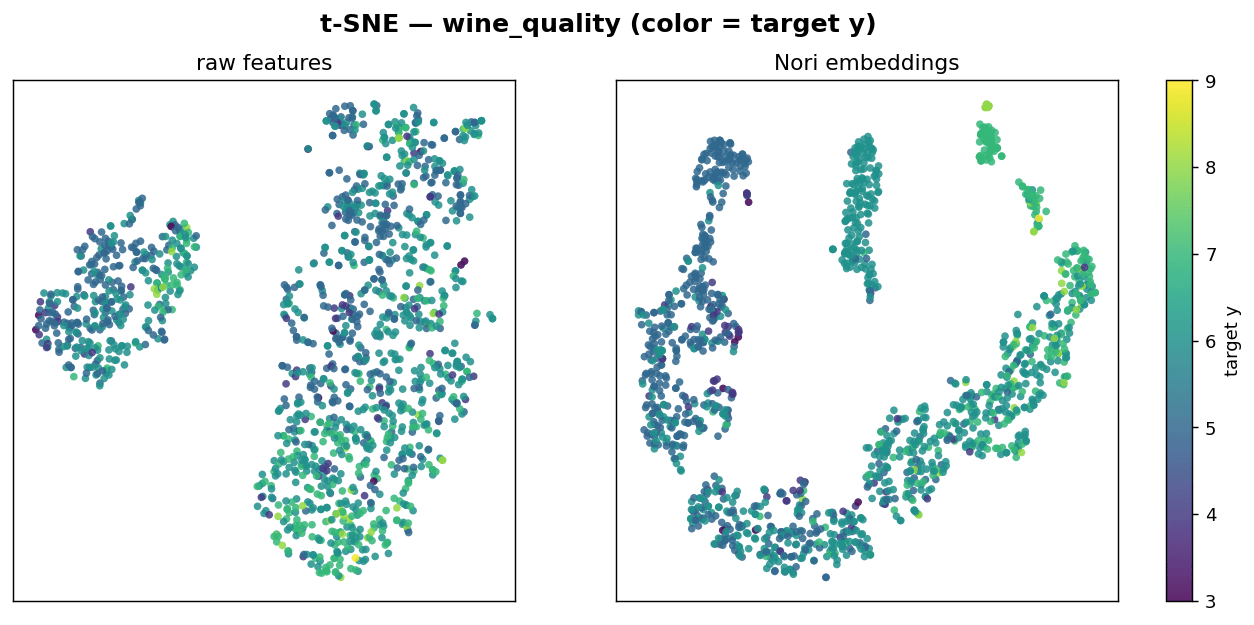
Because the vectors are organized by the target, a 2-D t-SNE of Nori embeddings separates rows by their target value far more cleanly than a t-SNE of the raw features. Both runnable examples below produce exactly these plots. To run them, clone the repo and add theeval extra — it brings in matplotlib, plus openml
for the TabArena example. See contributor extras.
- Synthetic dataset
- Real dataset (TabArena)
examples/embedding_synthetic.py
runs the workflow on a small synthetic regression target: it extracts
embeddings, runs a kNN probe, and draws the t-SNE. Fast, with no data
download.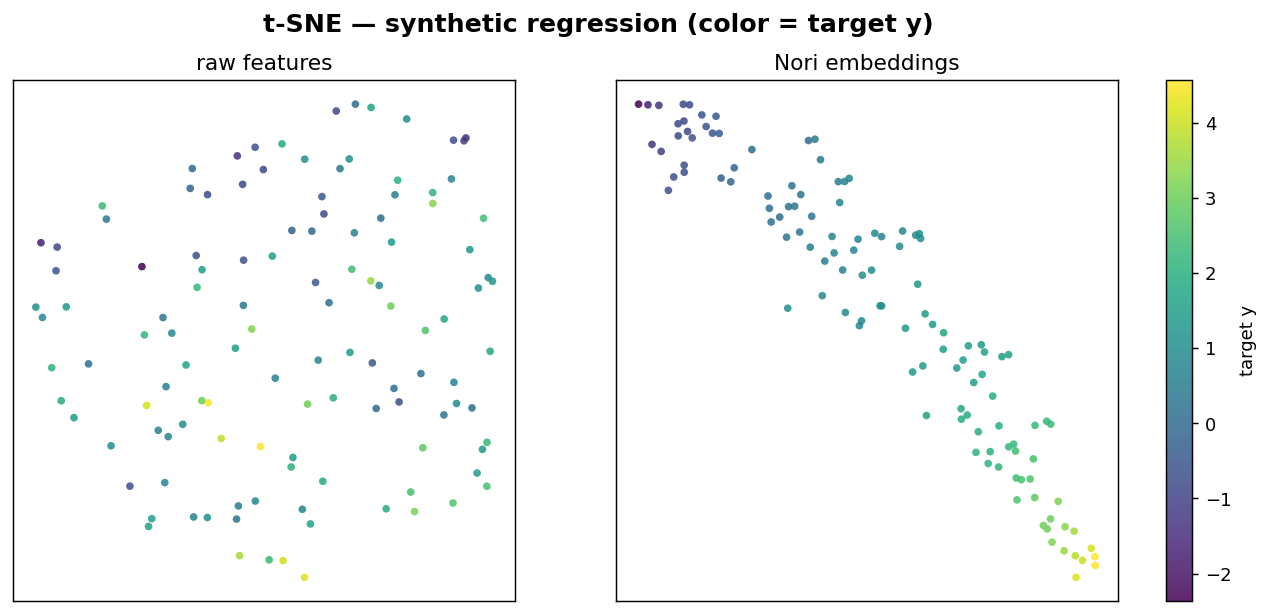
Synthetic regression, colored by target y. Raw features (left) show no structure; Nori embeddings (right) form a clean target gradient.
Z_test:
Configuration
NoriEmbedding parameters
NoriEmbedding parameters
After
fit, the transformer exposes model_ (the full-data model) and
train_embeddings_ (out-of-fold when n_fold >= 2).Downstream head snippets
Downstream head snippets
A standardized ridge probe (good default for the higher-dimensional
embeddings of real data):The same
Z_train / Z_test matrices feed clustering (KMeans), nearest-
neighbor search (NearestNeighbors), or any 2-D projection.Good to know
Shapes at a glance: embeddings are
(n_estimators, n_samples, embed_dim).
Average over axis=0 (or select [0]) before handing them to a 2-D estimator.Next steps
Forecasting
Turn a time series into a table and forecast it locally with Nori.
Explainability
SHAP values and partial dependence on the same fitted estimator.