

NoriRegressor is a scikit-learn estimator, it plugs directly into
shapiq — a fast SHAP implementation with
native Shapley-interaction support — and the rest of the sklearn
interpretability ecosystem. The helpers in synthefy_nori.interpretability are
thin convenience wrappers, so you can also use the underlying tools directly.
examples/interpretability_regression.py
These examples run locally with the
synthefy-nori package and its
interpretability extra, which pulls in shapiq. Follow
Installation before running them.Quickstart
get_nori_imputation_explainer builds a shapiq.TabularExplainer that removes
features by imputation against a background set. The training context stays
fixed across coalitions, so each coalition is a single predict call and the
cost is set by budget.
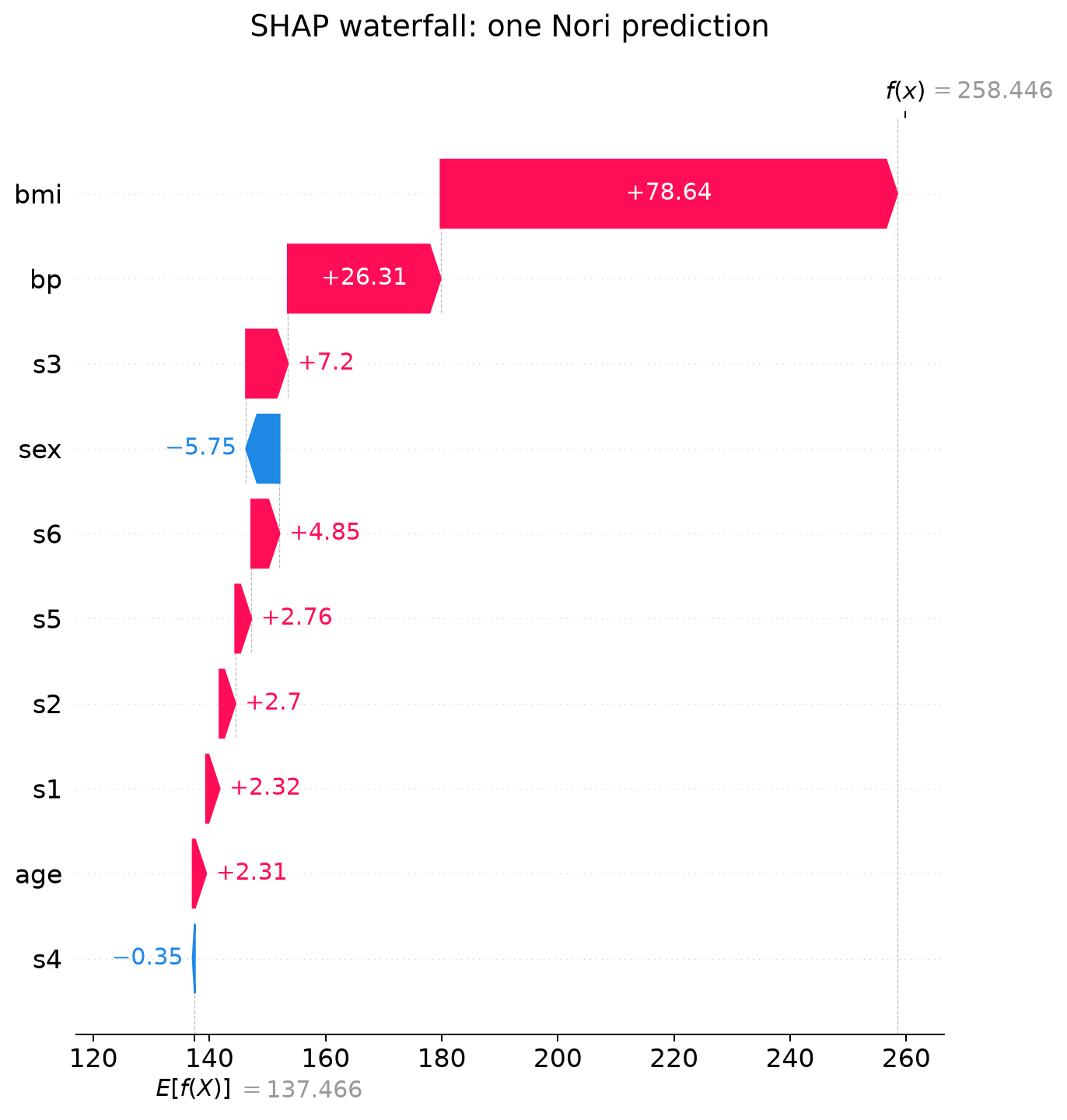
SHAP waterfall — each feature's additive push from the baseline to one prediction (sklearn diabetes).
Feature interactions
Use a separate explainer withindex="k-SII", max_order=2 for pairwise
interactions, which you can view as a network:
Feature interaction code
Feature interaction code
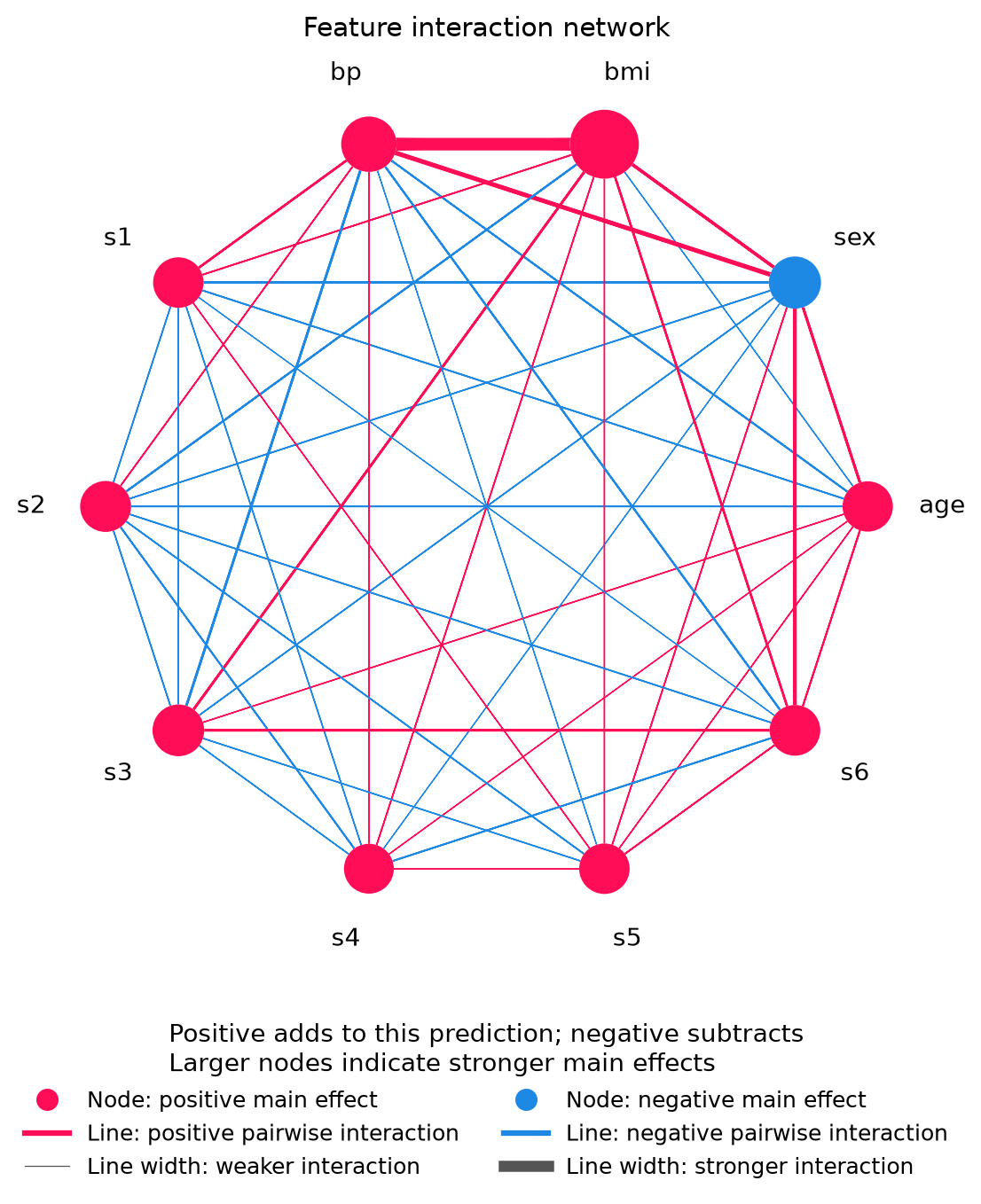
Pairwise interactions for one Nori prediction.
Partial dependence / ICE
(i, j) tuples in features for 2-D interaction surfaces. Returns an
sklearn PartialDependenceDisplay.
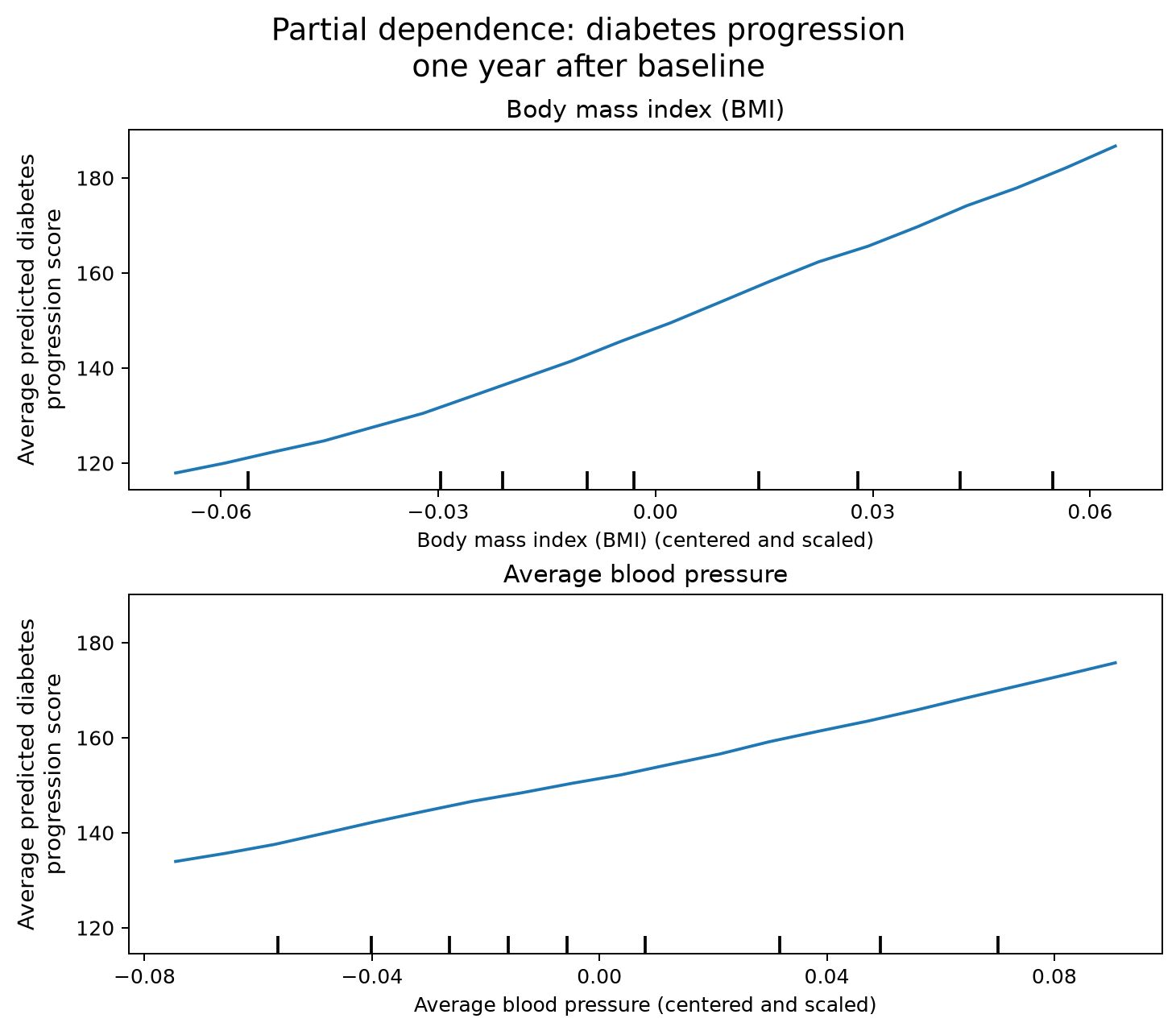
Top: vary BMI. Bottom: vary average blood pressure. Both y-axes show the average predicted diabetes progression score one year after baseline. Other features retain their observed test-row values before predictions are averaged.
Feature selection
Find a minimal feature subset that preserves cross-validated performance (sequential selection):n_features_to_select accepts an int, a fraction, or "auto" (with tol). The
result also reports baseline-vs-selected CV scores.
Sequential selection re-fits Nori in-context on every CV split, so keep it to a
few thousand samples and a modest feature count.
Configuration
get_nori_imputation_explainer parameters
get_nori_imputation_explainer parameters
Budget trades accuracy for cost. Start at
128 and raise only if the
explanation looks noisy: <10 features → 64–128; 10–20 → 128–512; 20+ →
512–2048.Good to know
- These run on the local Python package (
synthefy-nori), not the hosted API. - TabPFN’s fast Shapley path reuses a KV-cache across coalitions; Nori’s public package runs one forward per coalition, which is correct and budget-controlled, just not cache-accelerated.
Next steps
Glass-box Models
Distill Nori into a readable, shippable additive model (EBM) in one call.
Categorical & Ordinal Targets
Predict labels on a discrete scale instead of a continuous estimate.
Embeddings
Target-aware row vectors for probing, clustering, and search.