

NoriInterpreter turns
it into a standalone glass-box Explainable Boosting Machine
(EBM / GA²M) — an additive model whose entire decision logic is a set of readable
per-feature curves. You keep most of Nori’s accuracy but get a model you can
inspect, ship, and audit line by line, which is often what a review or a
regulated deployment actually needs.
examples/explainability_credit.py
Needs the
explainability extra (interpret-core, joblib, scipy). The
SHAP-based importance path additionally needs the interpretability extra
(shapiq).How it works
A singlefit(X, y) runs three steps and stores every artifact:
1
Measure importance
Fit Nori and score each raw input column by permutation importance — the
drop in held-out skill when that column is shuffled.
2
Prune to what matters
Drop the low-importance columns, keeping the smallest subset that still
retains ≥
retain (default 95%) of Nori’s skill.3
Distill a glass-box
Fit an EBM on the surviving features. It learns one shape function per
feature (plus a few pairwise interactions), so the whole model reads as
baseline + Σ per-feature contributions.Quickstart
Worked example — UCI Credit Default
examples/explainability_credit.py
runs the full flow on the UCI Credit Default table (23 features, ~30k rows,
downloaded fresh). The permutation ranking is dominated by PAY_0 — the most
recent repayment status — with the credit limit and earlier repayment months
trailing it:
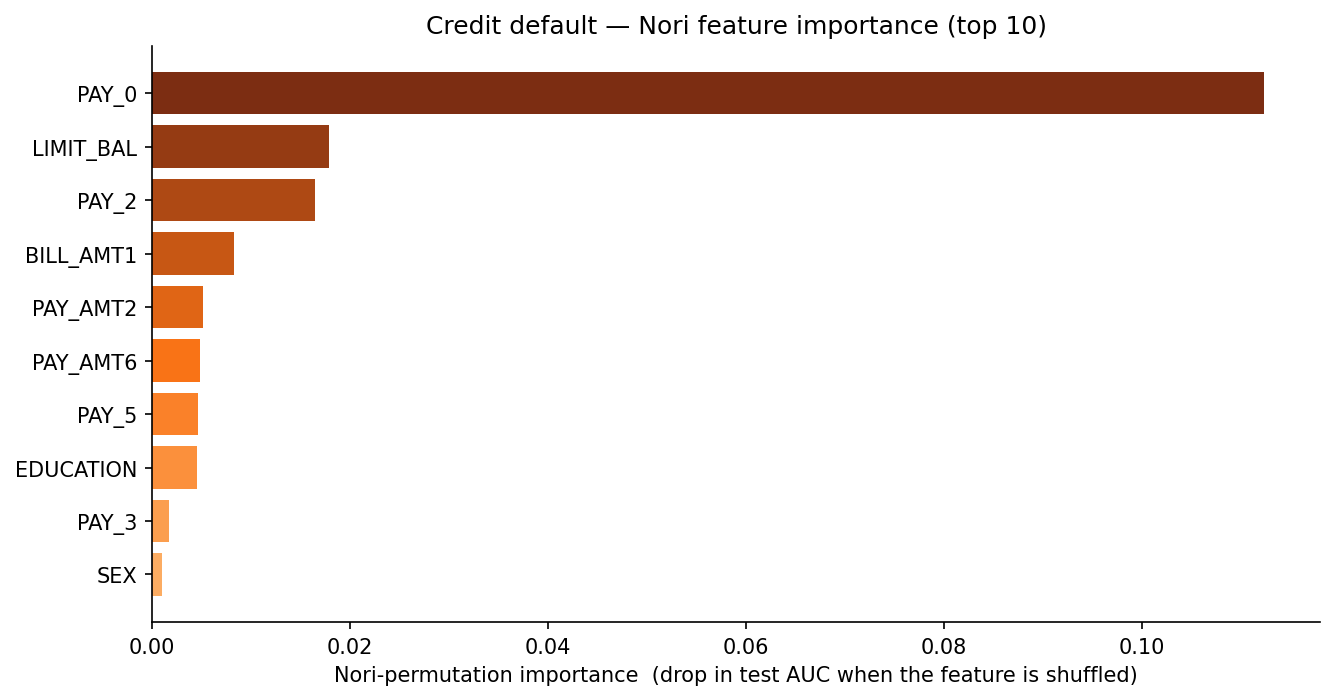
Nori-permutation importance (top 10). PAY_0 — the latest repayment status — carries most of the signal; importance = drop in test AUC when that column is shuffled.
Σ → σ node adds the baseline and every contribution into the final prediction:
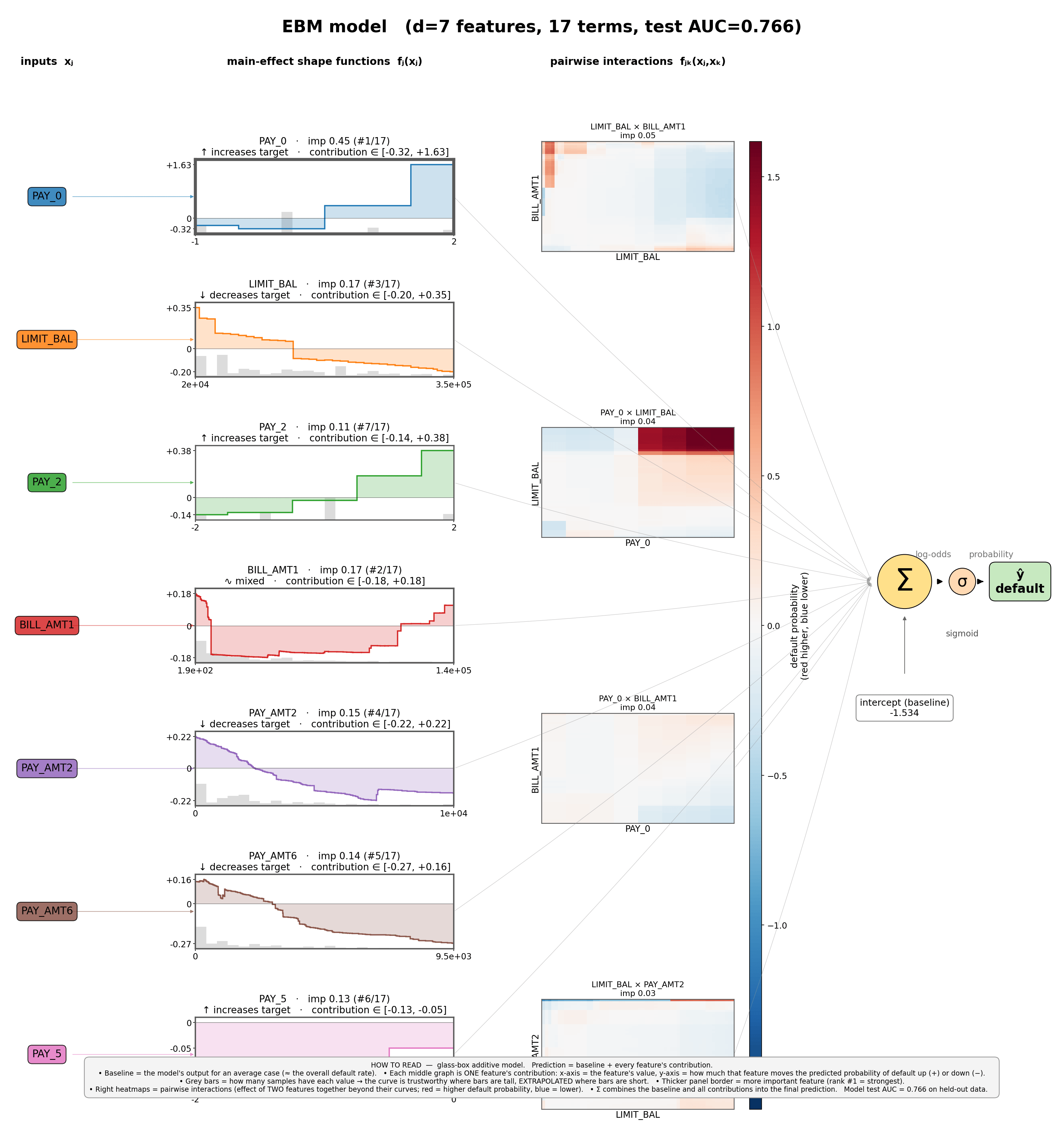
The distilled glass-box EBM (7 features, test AUC 0.766). Read left-to-right: each shape function maps a feature's value to how much it pushes default probability up (+) or down (−); grey bars show where the data is dense (trustworthy) vs sparse (extrapolated); Σ then σ combine the baseline and all contributions into ŷ.
Configuration
NoriInterpreter parameters
NoriInterpreter parameters
explainability.importance (nori_permutation_importance,
nori_shap_importance), explainability.ebm (fit_ebm, ebm_structure), and
explainability.pipeline (run, the end-to-end importance → EBM driver).
Good to know
- Runs on the local Python package (
synthefy-nori), not the hosted API. - Nori remains the source of truth for accuracy — the EBM is a faithful, auditable approximation on the selected features, so expect a small score gap (≈0.01 AUC on the credit example).
- For single-prediction attributions, feature interactions, and partial dependence, see Explainability.
Next steps
Explainability
SHAP / Shapley values, interactions, PDP, and feature selection.
Categorical & Ordinal Targets
Predict labels on a discrete scale instead of a continuous estimate.