> ## Documentation Index
> Fetch the complete documentation index at: https://docs.synthefy.com/llms.txt
> Use this file to discover all available pages before exploring further.
# Glass-box Models
> Distill Nori into a readable, shippable glass-box model (EBM) in one call — feature importance, pruning, and an auditable additive model.
Nori is accurate but, like any deep model, a black box. `NoriInterpreter` turns
it into a standalone **glass-box [Explainable Boosting Machine](https://interpret.ml)**
(EBM / GA²M) — an additive model whose entire decision logic is a set of readable
per-feature curves. You keep most of Nori's accuracy but get a model you can
inspect, ship, and audit line by line, which is often what a review or a
regulated deployment actually needs.
[`examples/explainability_credit.py`](https://github.com/Synthefy/synthefy-nori/blob/main/examples/explainability_credit.py)
Needs the `explainability` extra (`interpret-core`, `joblib`, `scipy`). The
SHAP-based importance path additionally needs the `interpretability` extra
(`shapiq`).
```bash theme={null}
pip install "synthefy-nori[explainability]"
```
## How it works
A single `fit(X, y)` runs three steps and stores every artifact:
Fit Nori and score each raw input column by **permutation importance** — the
drop in held-out skill when that column is shuffled.
Drop the low-importance columns, keeping the smallest subset that still
retains ≥ `retain` (default 95%) of Nori's skill.
Fit an EBM on the surviving features. It learns one shape function per
feature (plus a few pairwise interactions), so the whole model reads as
`baseline + Σ per-feature contributions`.
The task (regression or classification) is auto-detected — Nori itself stays
regression-only and scores the pruning, while the distilled EBM matches the
target type.
## Quickstart
```python theme={null}
from synthefy_nori.explainability import NoriInterpreter
interp = NoriInterpreter().fit(X, y) # full table; model="nori-6m" by default
interp.feature_importances_ # per input column (skill drop when shuffled)
interp.importance_ranking_ # [{feature, index, importance}], most-important first
interp.selected_features_ # the pruned feature set (kept ≥ retain of Nori's skill)
interp.ebm_ # the fitted glass-box model (shippable)
interp.summary() # {task, metric, n_selected, nori/ebm scores, top_features}
interp.plot_model() # draw the glass-box shape functions (below)
interp.predict(X_new) # score with the glass-box on the selected features
```
## Worked example — UCI Credit Default
[`examples/explainability_credit.py`](https://github.com/Synthefy/synthefy-nori/blob/main/examples/explainability_credit.py)
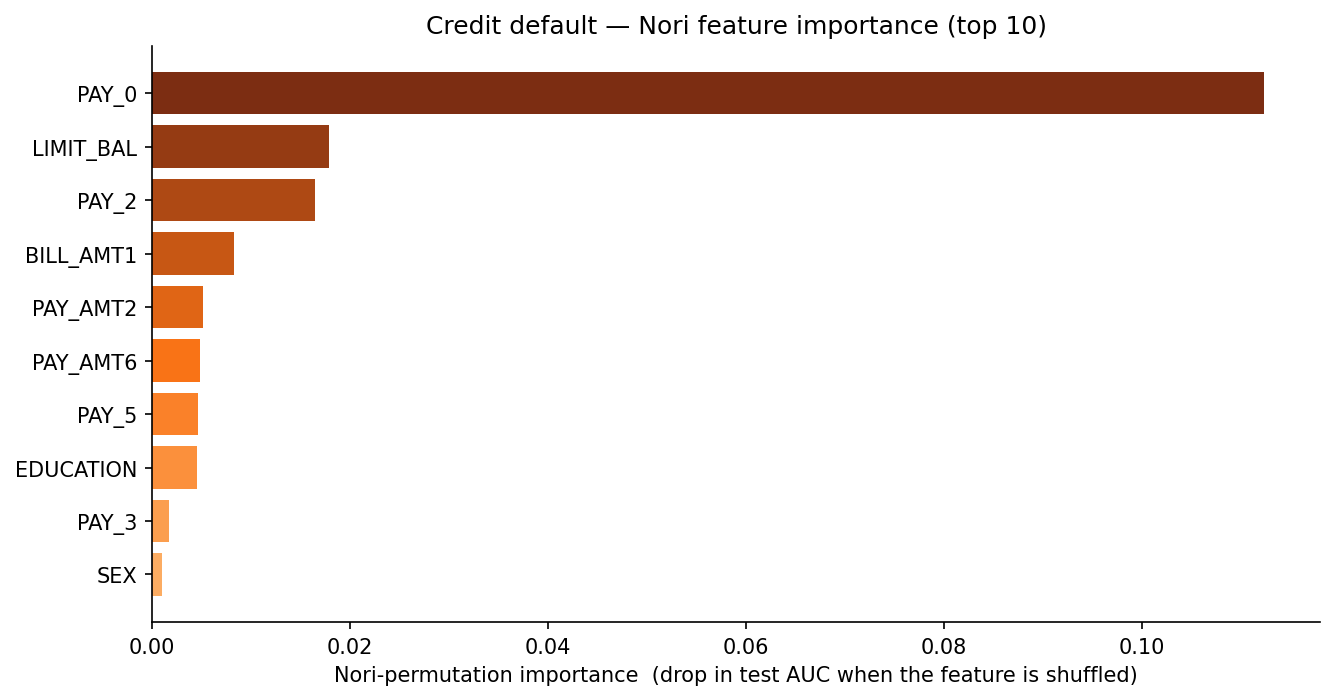
runs the full flow on the UCI Credit Default table (23 features, \~30k rows,
downloaded fresh). The permutation ranking is dominated by `PAY_0` — the most
recent repayment status — with the credit limit and earlier repayment months
trailing it:
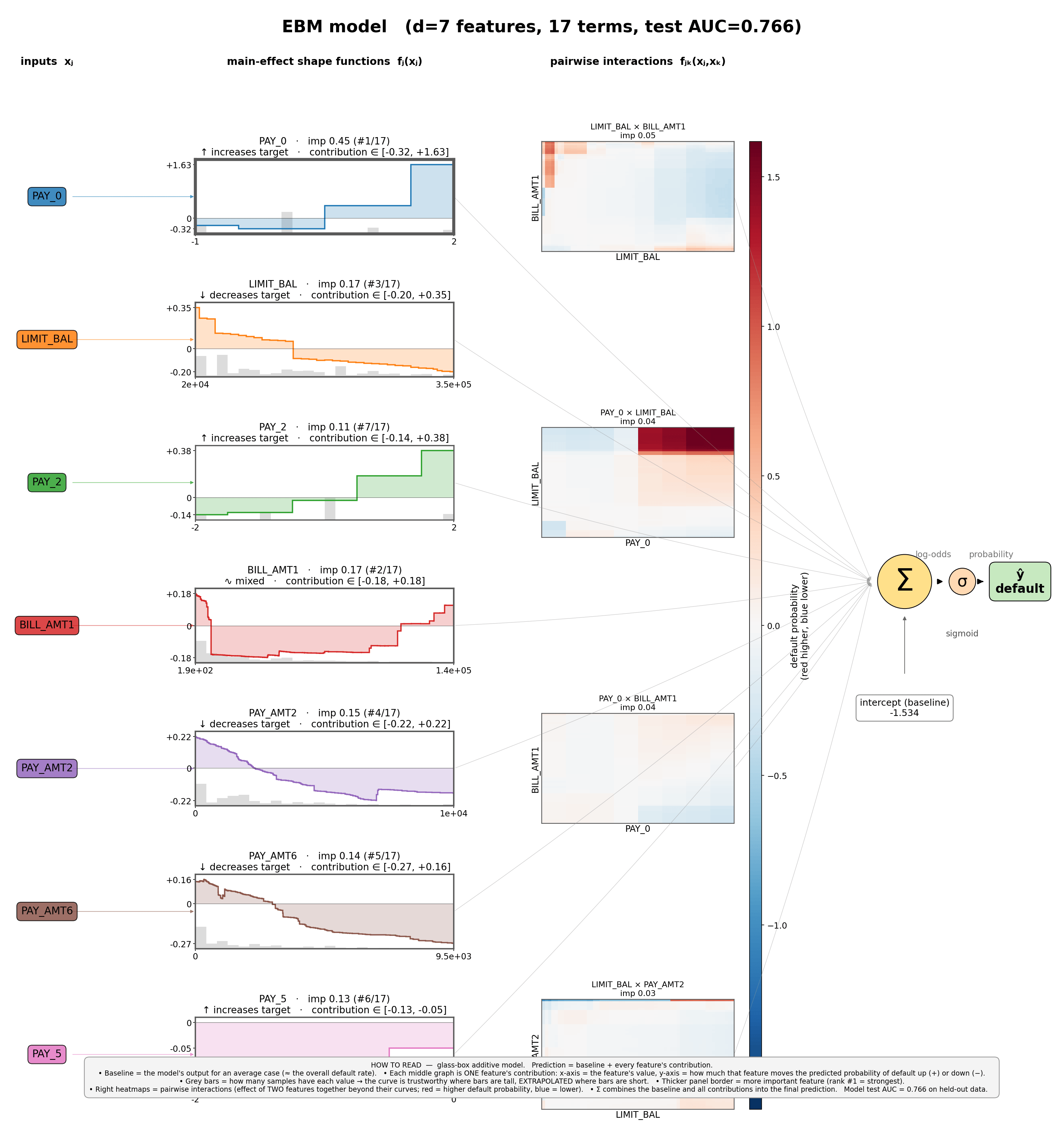
 Pruning keeps **7 of 23** features at the 95% bar, and distilling those into an
EBM costs very little: Nori scores **AUC 0.781** on all features, and the
glass-box EBM reaches **0.766** on the 7 it kept. The distilled model is fully
legible — each middle panel is one feature's contribution to the predicted
default probability, the right-hand heatmaps are pairwise interactions, and the
`Σ → σ` node adds the baseline and every contribution into the final prediction:
Pruning keeps **7 of 23** features at the 95% bar, and distilling those into an
EBM costs very little: Nori scores **AUC 0.781** on all features, and the
glass-box EBM reaches **0.766** on the 7 it kept. The distilled model is fully
legible — each middle panel is one feature's contribution to the predicted
default probability, the right-hand heatmaps are pairwise interactions, and the
`Σ → σ` node adds the baseline and every contribution into the final prediction:
 ## Configuration
| Parameter | Default | Description |
| ------------------ | ----------- | -------------------------------------------------------------------------------------------------------------------- |
| `model` | `"nori-6m"` | Nori checkpoint used to measure importance and score the pruning. |
| `retain` | `0.95` | Skill fraction to keep when pruning — the EBM is fit on the smallest subset that holds ≥ this share of Nori's score. |
| `reduce_threshold` | `16` | Only prune when the table has more than this many features; smaller tables keep every column. |
| `test_size` | `0.3` | Held-out fraction used to measure importance and score the pruning sweep. |
| `random_state` | `0` | Seed for the internal split and permutation shuffles. |
For finer control, the same steps are exposed as standalone functions — import
from the submodules: `explainability.importance` (`nori_permutation_importance`,
`nori_shap_importance`), `explainability.ebm` (`fit_ebm`, `ebm_structure`), and
`explainability.pipeline` (`run`, the end-to-end importance → EBM driver).
## Good to know
* Runs on the **local Python package** (`synthefy-nori`), not the hosted API.
* Nori remains the source of truth for accuracy — the EBM is a faithful,
auditable *approximation* on the selected features, so expect a small score
gap (≈0.01 AUC on the credit example).
* For single-prediction attributions, feature interactions, and partial
dependence, see [Explainability](/nori/explainability).
## Next steps
SHAP / Shapley values, interactions, PDP, and feature selection.
Predict labels on a discrete scale instead of a continuous estimate.
## Configuration
| Parameter | Default | Description |
| ------------------ | ----------- | -------------------------------------------------------------------------------------------------------------------- |
| `model` | `"nori-6m"` | Nori checkpoint used to measure importance and score the pruning. |
| `retain` | `0.95` | Skill fraction to keep when pruning — the EBM is fit on the smallest subset that holds ≥ this share of Nori's score. |
| `reduce_threshold` | `16` | Only prune when the table has more than this many features; smaller tables keep every column. |
| `test_size` | `0.3` | Held-out fraction used to measure importance and score the pruning sweep. |
| `random_state` | `0` | Seed for the internal split and permutation shuffles. |
For finer control, the same steps are exposed as standalone functions — import
from the submodules: `explainability.importance` (`nori_permutation_importance`,
`nori_shap_importance`), `explainability.ebm` (`fit_ebm`, `ebm_structure`), and
`explainability.pipeline` (`run`, the end-to-end importance → EBM driver).
## Good to know
* Runs on the **local Python package** (`synthefy-nori`), not the hosted API.
* Nori remains the source of truth for accuracy — the EBM is a faithful,
auditable *approximation* on the selected features, so expect a small score
gap (≈0.01 AUC on the credit example).
* For single-prediction attributions, feature interactions, and partial
dependence, see [Explainability](/nori/explainability).
## Next steps
SHAP / Shapley values, interactions, PDP, and feature selection.
Predict labels on a discrete scale instead of a continuous estimate.